• AFH
  • 4Dimensions
  • News
  • AFH Projects
  • About Paul McLean
    • Generic Bio
    • DIM TIM: Fallacies of Hope
    • Reel
    • Sample Text: On Concentricity [Brooklyn Rail]
    • Studio
    • NMNF Blog
  • Contact
Art for Humans

[Paul McLean]

  • AFH
  • 4Dimensions
  • News
  • AFH Projects
  • About Paul McLean
    • Generic Bio
    • DIM TIM: Fallacies of Hope
    • Reel
    • Sample Text: On Concentricity [Brooklyn Rail]
    • Studio
    • NMNF Blog
  • Contact

HW#1_6/8: Rushkoff

Time in Geneva, 2010 [PJM]

Time in Geneva, 2010 [PJM]

The first two chapters of Douglas Rushkoff's Program or Be Programmed sound warning bells for media users/consumers to take an active, aware stance for responding to technology where it impacts quality of life. His message effectively counterbalances the prevalent tech-push marketing driving generational advances in hardware, software and network capacity.

In part Rushkoff's arguments emerge from linking anecdote and historicity. He traces social-tech-media phenomena by pinging the familiar as it blurs into ubiquity. Ruskoff's main premises represent a distinctive take on Time and Place where they are implicated in our measurable (and sensed) relations to new media:

'House of Yes' Performance, 2011 - PJM

'House of Yes' Performance, 2011 - PJM

  • [TIME] - Because computer code is biased away from continuous time, so too are the programs built on it, and the human behaviors those programs encourage.
  • [PLACE] - (D)igital media are biased away from the local, and toward dislocation.
"Coordinating Time & Place (2011)" -PJM

"Coordinating Time & Place (2011)" -PJM

Rushkoff's keen observations and concern are valuable for anyone evaluating the effects of technology in the social sphere, from the self-management perspective. The author's message could benefit from dimensional analysis, with respect to temporal orientation and the many means by which location spans the virtual and actual "worlds" today. Our experiences of time and place are to varying extents externally imposed and consecutively variable. As I see it, it is a matter of 4D+ dynamics. It is interesting that Rushkoff opens his "Commands" with macro-issues that are as relevant in physics or astronomy as they are as socio-anthro-psych micro- or behavioral issues. For the latter discourse, the Panopticon pertains, and one would think the political, economic and other power distribution systems would be more prominent in Rushkoff's text. I would look to Agamben's investigation of Command for amplification.

"Network [optimal Command/Control]" - PJM
"Network [optimal Command/Control]" - PJM

Sunday 05.28.17
Posted by Paul McLean
 

HW#1_4-5/8: On/Off, Parts 1 & 2

PJM: In my production practice, I have recognized the necessity of properly situating "virtual" devices - electronics devices, such as desktop and laptop computers, phones (which are now practically equivalent to computers in some aspects), iPads, etc. - in a sustainable use/time configuration with other activities, which aggregate in the loosely-termed "analog" end of the doing-being spectrum pertinent to making, to creating stuff. It helps to experience immersion in the virtual at some point, to gain perspective on the stakes. My introduction to the absorption, induction, subsumption complexes attaching "real" people/users to digital systems came via networked gaming, although the symptoms were there the first time my dad brought home ATARI and my brothers and I discovered PONG. I can discuss the strategy/tactics/theory of integrated analog/virtual production for artists at length. It is central to my process. Here are some strategic actions I take in the spirit of ON/OFF best practices:

  • Stop for your body
    • Take a walk
    • Make coffee, or take a coffee break at your local cafe
    • Fix a healthy meal
    • Take a nap
    • Stretch, breathe, move
    • Exercise
  • Prioritize family- and friend (F&F) time-
    • Schedule meals and breaks with other reciprocally significant humans
    • Ask proximal F&F for feedback on your virtual habituation
    • Be mindful of e-anxiety during F&F exchanges and events
  • Be routinely e-free in nature
  • Construct your own Time
    • Manage the Clock(s)
    • Be time sensitive, so you can find (healthy) timeless space to be in
    • Try timed meditation, metronomic workflow, Stopped-clock experiment
  • Discuss best practices with other digi-creatives
  • Research best practices for digi-creatives
  • Make a list of known warning signs that you are overdoing it; if you routinely fail to behave as if you care for your "total" well-being, relative to digital activity, at least talk to someone who will prioritize you over whatever virtual fix you "need" or bad habits you have hardwired in your wetware
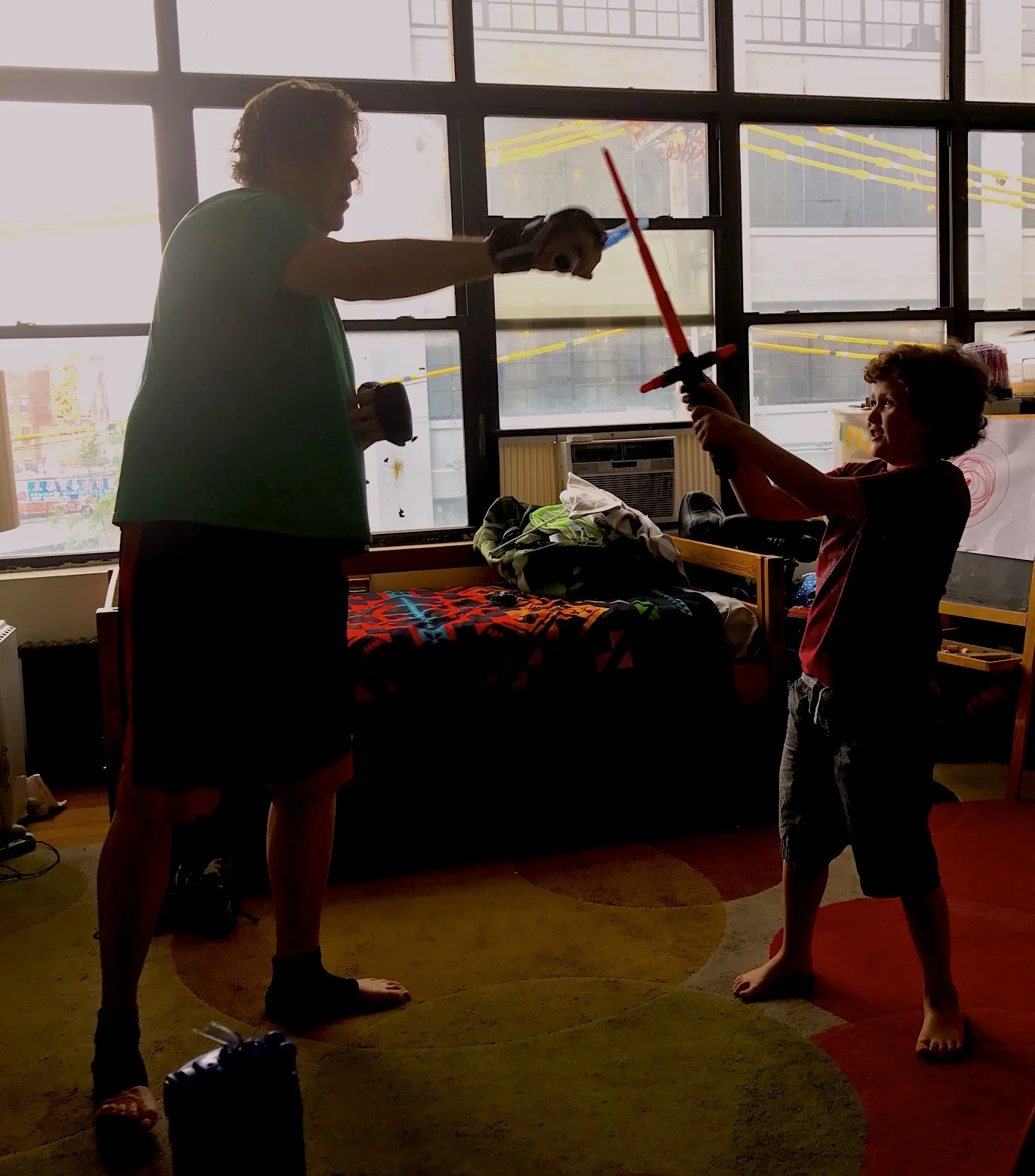
Having a five year-old makes ON/OFF fun!

Having a five year-old makes ON/OFF fun!

Afterthoughts

In my mind, strong definitions of "art" help me map my relations to the digital/virtual environment. I have generally kept the analog and electrified areas of my practice segregated. That said, there are certainly many "spaces" that contain both facets of my creative work. I do give myself permission to explore analog (and virtual) extremism. For instance, I have undertaken to create paintings consisting of parts made through minimal machining. The "material" I use is always interrogated. Similarly, I have created many strictly digital or "digital native" artworks. The italics are there intentionally. "Digital art" is theoretically unresolved at this point, in my view. Baudrillard looms large in this matter. I believe it is incumbent on each artist to apportion awareness to the questions: "What is art?" and "Who is an artist?" and "What is art for?"... Further, any artist who combines digital and analog in her creative enterprise benefits from inquiring about those terms, their applications, attached theory, and so on. To me this is simply a question of curiosity, on the one hand, and on the other, a function of craft, techne. The capacity for any artist to communicate in the presence of art and viewer thoughtfully, conscientiously, is supported by the practices of curiosity, expressed in the material. Social reflection emerges from a sound medium of practical awareness, drawn from the acts of making, with their continuum of internal and external aspects.

ON/OFF Drawing #1 [Ink on Paper (27 May 2017)]

ON/OFF Drawing #1 [Ink on Paper (27 May 2017)]

Saturday 05.27.17
Posted by Paul McLean
 

HW#1_3/8

eEtiquette

ee1.jpeg
ee2.jpeg
ee3.jpeg

I like these selections for their subtle paralleling: actual/virtual (self-)equivalence; the prospect of virtual mortality and afterlife as a generative forethought; the conflation of the types of memory we assign to virtual "life"... I don't consider any of these projections to be conclusive. The site's faux embroidery "skin" is attractive, unusual, and given the content, somewhat creepy.

Friday 05.26.17
Posted by Paul McLean
 

HW#1_2/8: Arts Organization Profile

Creative Profile (Arts Organization) 

Co-Lab Projects, Austin, Texas

Eric Timothy Carlson’s “Waves of Joy” at Co-Lab

Eric Timothy Carlson’s “Waves of Joy” at Co-Lab

PJM: I selected Co-Lab to profile, based on my history with the Austin non-profit and its founder, Sean Gaulagher [see below]. Since 2008 Co-Lab has produced impressively diverse and compelling programming, featuring many artists and creative approaches through solo, collective and group exhibitions, performances and installations. The virtual components of Co-Labs operations never fail to enhance the immediate and visceral qualities of its presentations. As producers, the Co-Lab team, which over the years has changed and evolved in the direction of excellence, has evidenced respect for artistic processes of many descriptions, consistently provisioning support services that have made sometimes difficult work accessible and approachable for the Austin arts community. Providing a needed "anchor" art-org in East Austin during the district's emergence as a cultural destination, Co-Lab constructed a trusted brand with sound connections to other arts and culture hot spots and activities, such as Bolm Studios/Big Medium, the East and then West Austin Studio Tours, and the Texas Biennial. Working collectively, these and other successful projects (e.g., OK Mountain) added much to an art scene dominated by the University of Texas' arts programming and a few additional institutions, including the Blanton and The Contemporary Austin museums. Over its lifetime, Co-Lab has gone through the typical phases of medium-sized city independent contemporary art not-for-profits. In 2012-13 it was short listed for a Rauschenberg Foundation grant. In 2015 Co-Lab lost its original space and has since navigated a period of occupying temporary and satellite spaces. Throughout its tenure, however, Co-Lab, Gaulagher and the artists they serve have continued to provide quality art events and exhibits for Austin art lovers. To get a sense of the remarkable variety of Co-Lab's programming, review the "Past Exhibits" section on the Project's website.

[In 2005 I produced a series of exhibits, a formal lecture, and a technical residency at St. Edward's University. During the 4- or 5-month production, I rented a working spaces, one of which was located at Shady Tree Studios. Sean was one of STS' managers/facilitators. My studio rental at STS transitioned into its own residency-like thing, during which I helped STS develop an exhibit program that still exists today (Pump Project), produced my own solo exhibit, and helped coordinate the founding of Cantanker, an Austin contemporary arts zine, which enjoyed a nice multi-year run. Sean moved on from STS to establish Co-Lab, and I exhibited there in 2012. I visited Sean in his temporary project space across the street Contemporary Austin in April. On view was an interactive installation of 500 piano wires attached to floor and ceiling ("String Room" by turntablist Maria Chavez), coinciding with the 2017 FUSEBOX festival.]

Co-Lab website: http://co-labprojects.org/

Friday 05.26.17
Posted by Paul McLean
 

HW#1_1/8: Artist Profile

PJM: I am selecting my friend Joseph Nechvatal for the assignment. We began corresponding I think @10 years ago. The correspondence developed into a rich friendship, and one of the most valuable exchanges I have experienced in over three decades of artist2artist relationships, which I have discovered have a particular quality. Joseph, that said, is certainly acknowledged in the "art world" as an accomplished maker, thinker, writer, educator, arts and social activist. His art-technical achievements are unique in many respects, especially in the area that conjoins the digital/virtual, fine art, performance and theory. Joseph is a pioneer - e.g., a co-founder of thing.net and the prime virus art practitioner, plus much more - but he is in deep relation to both the history of art and its currency, as evidenced in his art-beat writings for Hyperallergic. As his longer texts demonstrate, Joseph is remarkable in his capacity to synthesize the many facets in play in art's creation, whatever the metadatic context, through what I might describe as the humane lens. Joseph brings a distinct quality of emotional coherence to his analysis, which may be associated with his fundamental openness to creative collaboration. Finally, Nechvatal inevitably introduces to his projects a sense of celebration, if not ritual, that is tolerant of complexity, flux, transgression, loss and a broad spectrum of experience and urgency beyond or in spite of convention. His is rarely a lonely or disengaged art, and this is obvious in what Joseph introduces in his pedagogical instruction, too. Perhaps what is most rare, and by that I mean special, about all the integrated phases of his life and art, is its consistency over time. Nechvatal's rigor, his sustained and dedicated effort is behind it from "start" to "finish," from conception through creation to presentation. Yet, in this viewer's estimation that rigor is never burdensome, either as a feature of production or its immaterial component. Spirit, or at least the wondering about spirit is always present in Joseph's work, and that wonder is not divorced from sensation and the mechanical, or physical reality insofar as it can be shared. I think this is a an abstractly conscious thing, like certain meta-poetry, and Joseph is a master at intertwining expressive fields, and a doctor, whose healing motivation itself invokes the amelioration of inevitable and unnecessary suffering alike, if only in a transitory instance of elevation/revelation through art by all means, via the best available technics.

Nech-1.jpg
-2.jpg

More links:

  • A 2012 interview with JN: http://www.eyewithwings.net/nechvatal/interview2012/Nechvatal_2012_Interview.htm
  • Joseph's YouTube portal: https://www.youtube.com/user/Nechvatal
  • Wikipedia: https://en.wikipedia.org/wiki/Joseph_Nechvatal
  • Joseph's website: http://www.eyewithwings.net/nechvatal/
“This color and light was joy. You know, when I think of light and color now I think of the computer, of course, and it makes me think of virtuality, which is potentiality. You know, it’s like anything’s possible when you’re in the realm of light and color. They’re just the building blocks for almost any future that you could imagine. So, that’s all I can tell you.”
— Joseph Nechvatal [from a 2012 interview with Taney Roniger (linked above)]

Other artists I considered for the assignment:

  • Artie Vierkant
  • Cory Arcangel
  • Roy Ascott
Friday 05.26.17
Posted by Paul McLean
 
Newer / Older