
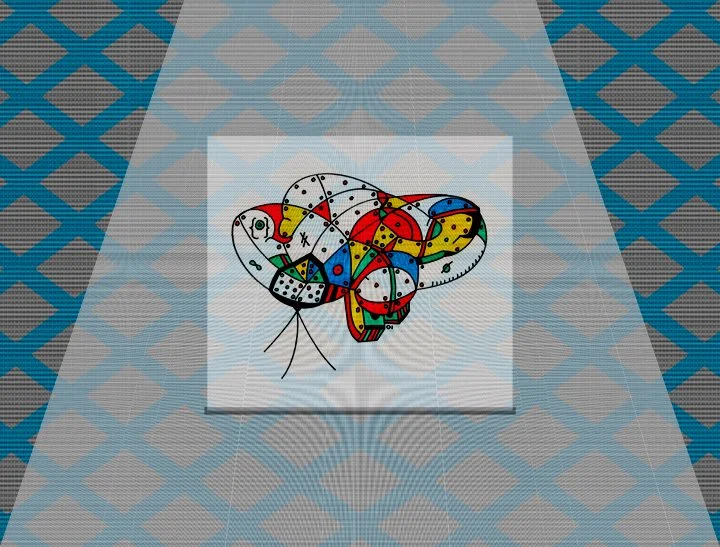
Part 1
As an undergraduate art student at Notre Dame in the 80s, I obsessively researched, pouring through the main library’s stock of 25,000+ coffee table books. Henry Moore was one of the first artists to grab my attention, and he still does. A few hours ago I saw in my instagram feed a wonderful clip extracted from an antique documentary that zoomed in on the famed sculptor’s hands and tools. I realize I hadn’t come close to an encyclopedic knowledge of the canon, and never will. It may not be humanly possible. An open question is whether AI could make it so. Or whether there is any likelihood of a coordinated public/private project to chart, catalog and explore the role of art in civilization. A database, in a word. In 2026 it is fair to ask why and for whom such a thing should be contrived. Admit it. We can no more agree on what art is, than we can war or peace, right or wrong. “We” has lost the semblance of cohesion, and meaning is hanging on by a thread!
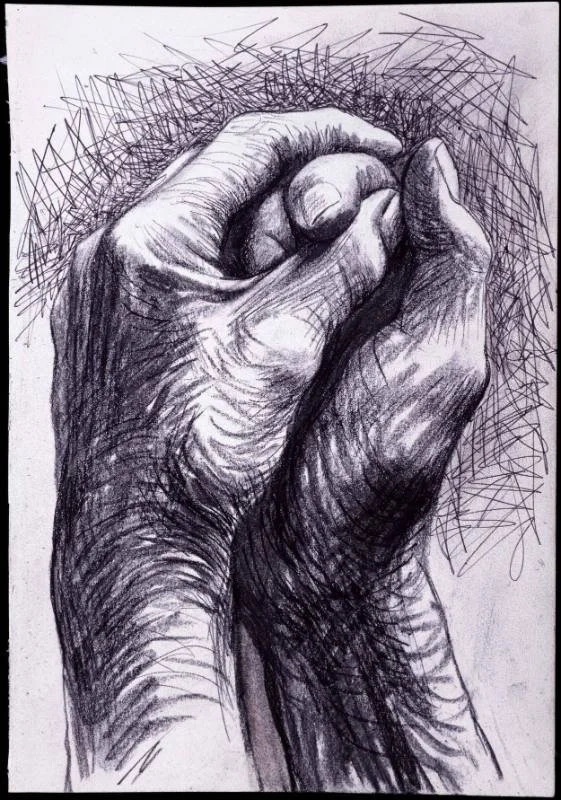
x Henry Moore
I vaguely recollect Google trying to launch a comprehensive online culture portal and library, a warehouse for digitized artifacts, but copyright foiled the attempts some time ago. Those in a position to decide whether or not to launch such a vast humanitarian effort appear to have had other plans and priorities for the technology, and attaching civil policy, governance. How to justify or rationalize the turn from art to techno fascism, or whatever this is? Expediency or efficiency? God gave us permission? Because force can be expressive, too? Is it a turn or an eternal dance? The all-in gamble on Artificial Intelligence ended the West’s Enlightenment once and for almost all. Instead of archives and a 21st Century New Deal, we are training machines to replace humanity, draining water reservoirs, burning through stockpiles of munitions and mismanaging energy in crazy ways.
The Conformist
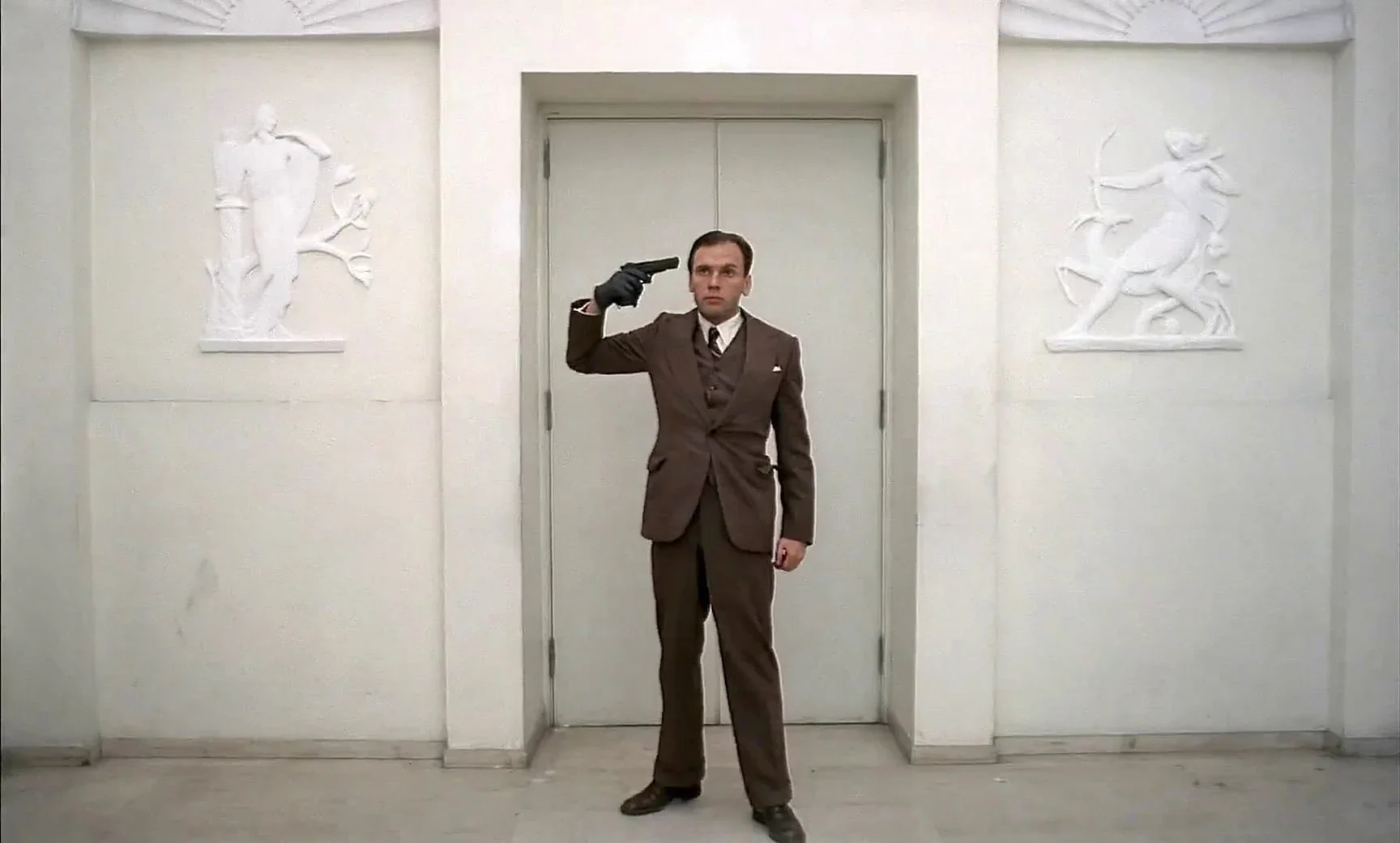
It’s Monday and for the first time I watched Bertolucci’s The Conformist — on our big flat panel TV, wireless via YouTube, with subtitles. The Plato’s Cave scene was magical, in the sense it precipitated in my mind a series of contingencies, congruencies, revelations. Cinema can do this. Suddenly I could vividly recall lectures, texts, arguments, art pieces, mine and others, linked to the ancient conjecture. I found this cascading effect to be immensely pleasurable, but sad, too. The past manifests in a sequence of memories, analogous to the behavior of water, its flow properties. Plato’s imaginary subterranean souls and their shadows are a staple of my artistic and philosophical construct, a foundation principle — not that I’ve adhered to it constantly, not at all. Bertolucci is right to apply the Platonic allegory towards the messiness of fictional assassination. Plus I adore the movie’s marvelous abased classicism, its visceral grittiness and sexy materialism, woven into the script, the production design and cinematography. The Conformist's relevance to 2026 geopolitics to me is obvious. Causality and interpretation are problematic differently, in violent dramas of desire. Time travel is the cheat code for all psychic illusion and fleshy fantasy.
Heidegger
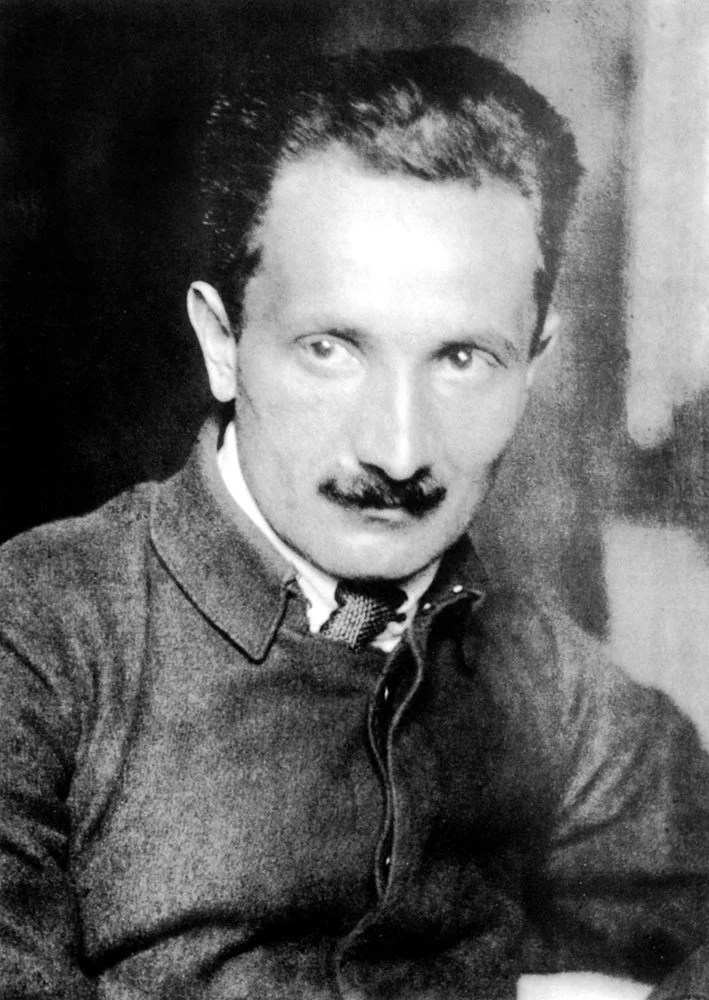
If you follow my practice, you know I’m ever curious about dimensional platform dynamics and effects. Lately, my curiosity has me chasing albino rabbits in Meta fields. Yesterday I entered a string of prompts like “media theory” and “4d art and design,” and waded through the hate- and lust-infused slop, until the content stream’s flow shifted. Eventually the seam, the thread, led to Martin Heidegger. Maybe Heidegger was right about being - I don’t feel qualified to argue for or against his assertions. Nor do I know how to reconcile the old black and white interview displayed on my iPhone screen, with the 1000s of images before and following in the gram’s generative AI chain, the appropriately nicknamed “doomscroll.” Zizek and Kittler made cameos, me swiping, clicking away with my good left hand. Angelicicism/Film01 (now Sex mag) increases in significance daily, in my estimation. Major cine finds were The Battle of Algiers and Tarkovsky’s The Stalker. Takeaway: Displacement and disorientation are existential givens, the norm, over the past couple of millennia, and may have always been.
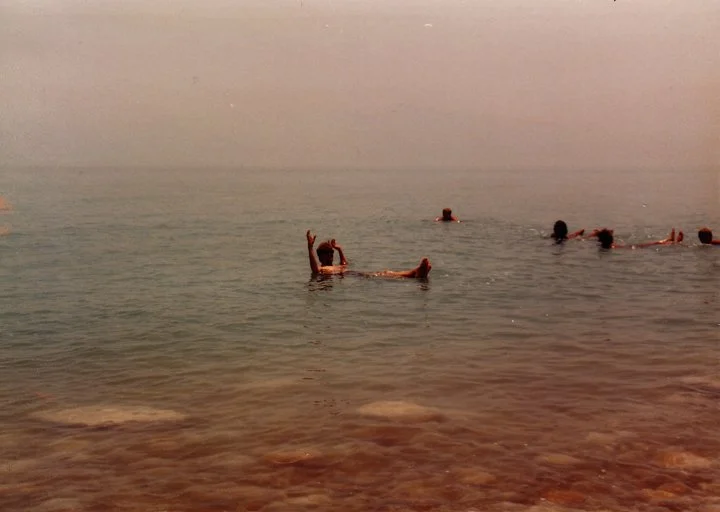
Floating on the Dead Sea
I was in Israel in the heat of summer in the early 80s at the caves near Qumran, where the Dead Sea Scrolls were discovered, on a field trip led by the then-spry little Englishman scholar and theologian called Joseph Blenkinsopp. The previous semester, I had signed up to work on an archaeological dig in Capernaum. Most of my Domer classmates preferred Eurail passes. On my formative journey to the Middle East, I took hundreds of pictures with a Nikon my dad gave me. Next stop, we visited the Dead Sea. I floated on its salty buoyant waters, careful to keep my damaged finger out of it. I had no nail on the middle one. A rock from a Roman wall had crushed the tip, but that’s another story about searing pain, the Chagall windows at Hadassah, the killing of the Son of God, Megiddo, the Israeli wars in Lebanon and Michael Jackson. Was mine a truly different Israel than today’s version, and how does either measure against the one polluting my Instagram, or the Michigan Senate race? My God, you would not believe today’s pixillated Holy Land’s shocking ugliness, brazenly churning in the sordid banality of the streams. Its depravity spreads like a plague of locusts to New Jersey, Paris, the Phillipines. Darkness unfathomable. The spectrum of stylized reactions, like Kabuki, or German Expressionist performances, or Baudrillard’s orgies, are consummately troubling. Because they situate grief, outrage, bloodlust and so on together in the attention market-machine. The entire apparatus is absolutely craven, a complicity vortex.
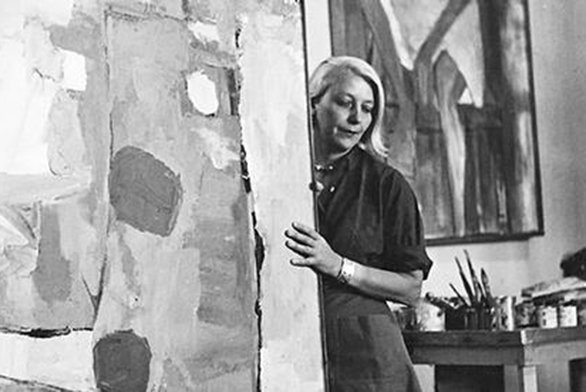
Janet Lippincott
At the fringe of one night’s slumber, I reminisce about the artist Janet Lippincott, who was so kind to me when I was starting out. She bought me lunch at Babe’s on Canyon Road, a sandwich probably. [The quality of my reverie is variable, ranging from sharp particulars to fuzzy impressions.] Janet invited me to visit her Upper Canyon Road compound, with all those feral cats. I didn’t know how do get comfortable there, due to my substantial angst. Which is too bad, because the old gal was a gem. Janet and her paintings were fashioned of the the same indomitable spirit that defeated Hitler on the Western Front, A bloody stubbornness, angry and grieving all at once, repulsive and lonely, raw, bitter and deep. She was uniquely authentic to the bone, but unlike the so-called influencers, Janet achieved a persona the old fashioned way, through hard-lived experience, not pantomime. Periodically, the essence of freedom itself manifested in her art, which is not the same as beauty, exactly. Forgive me. Accidentally, I have resorted to telling a ghost story again. The American West, the High Desert, it absorbs and buries the 20th Century in its arroyos and shadows, like all the other times. At the risk of sounding metaphysical or poetic, Cormac McCarthy solved a semiotic iteration of the hypercube at the Santa Fe Institute, which is located about a mile away from where Janet lived, before expiring. I can’t get his books out of my head, especially the last couple, Stella Maris and The Passenger. Blood Meridian changed my concept of America forever.
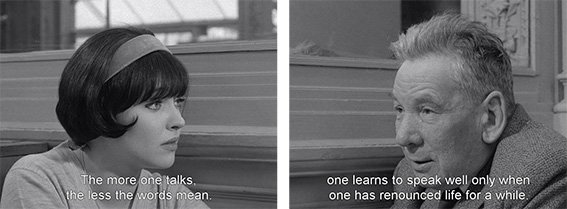
Vivre sa vie
In the afternoon I queried “the best of French and Italian cinema” and was rewarded with ranked lists. Zombie Hollywood remains in a state of collapse, while the mergers and acquisitions dominate entertainment news, with the sporadic blockbuster hype as a counterbalance to industrial atrophy and condemnation. This afternoon I watched Goddard’s Vivre sa vie. The brilliant cafe conversation (again Plato!) is magnificent and cruel. A paradigm lives within it, welding the infinite to the mortal flesh, sparkling in the tragic dialogue between a wizened thinker and a soon-to-be-murdered whore. The overlay of irony thick as cigarette smoke. Since the Stroke my mind is prone to ideological or aesthetic drifting. During these trauma-induced flights of fancy, LOL, it’s a matter of intellectual diligence, spiritual protection, or emotional discipline to veer away from despair and such negativities as the smog of malaise foists on a damaged brain. Grace must be invited and indulgence repelled, actively, on the daily. Truth be told, after the intensity of my days-long immersion in the algo-swamps and data-palaces, I am afraid art, literature, thought itself, are barreling toward extinction, along with the Real. Just an observation — not a preference, a diagnosis, not a prediction or prognosis. The future is not written, but it may be illiterate. I rediscover Noah Becker on IG, after a long separation, and rejoice.
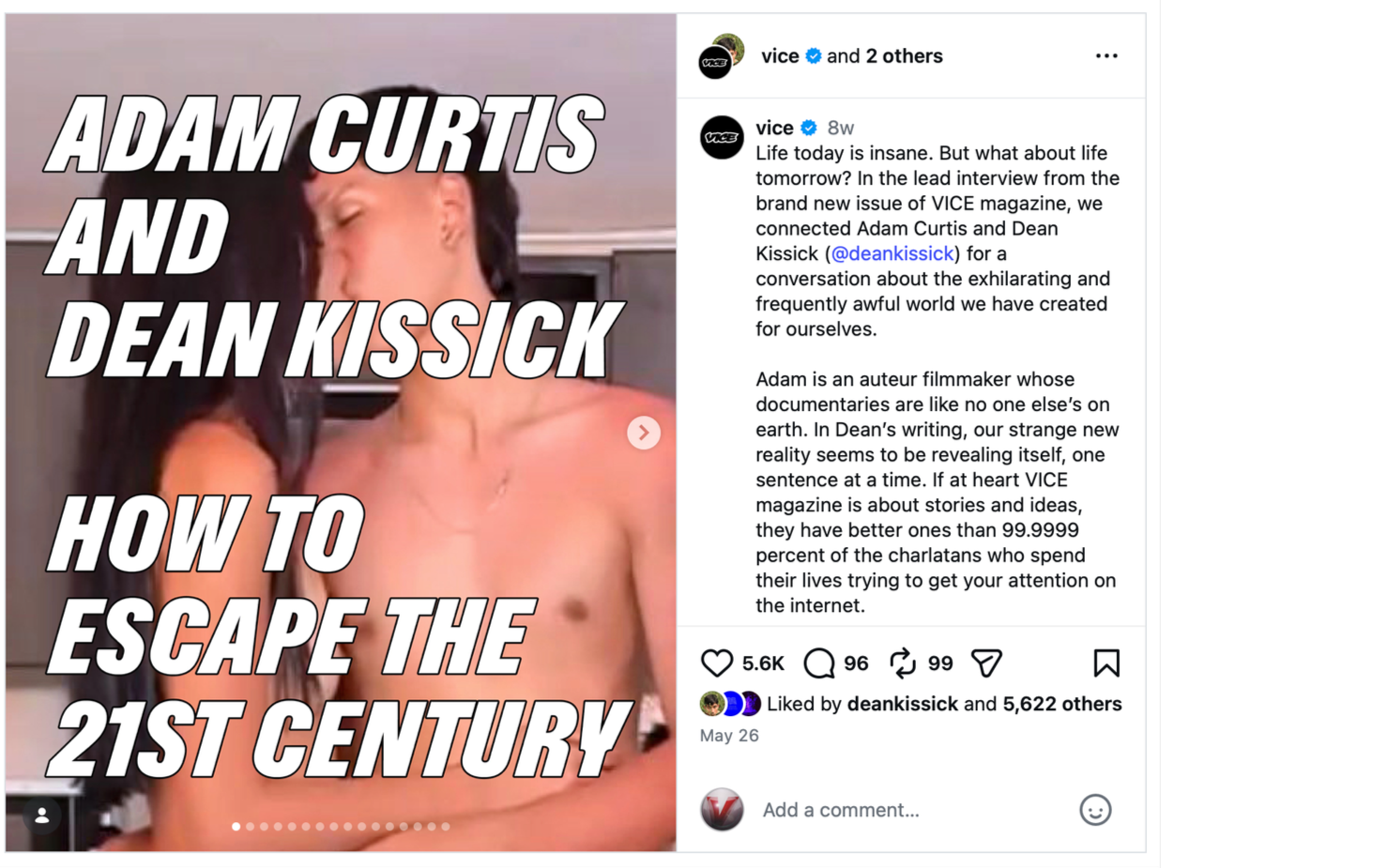
x Vice
n the mayhem of history’s prolonged suffering and demise, post-mortem (credit Fukuyama, Neitzsche, et al.), one circles back to Adam Curtis chatting mournfully with Dean Kissick behind a paywall, which I manage to breach. I don’t think either of them actually gets art as an artist does, effortlessly, which is to say, naturally. Yet, their observations are crucial, and devastating, in conjunction with or as an amplification of Curtis’s programs and Kissick’s recent critical essays. Inevitability — the ending of things — is in the air, isn’t it? The glorious and corruption-poisoned World Cup of 2026 and its blissful and tragic melodramas were a fantastic, if stunted, diversion. Messi. The interventions of tech, Trump and Madonna. The heat, ICE, the unavoidable subtext of diverse global terror, of ghastly stultifying inequity. Fright was attending the feast, but we again escaped with our skin intact.
x Martin Fuller
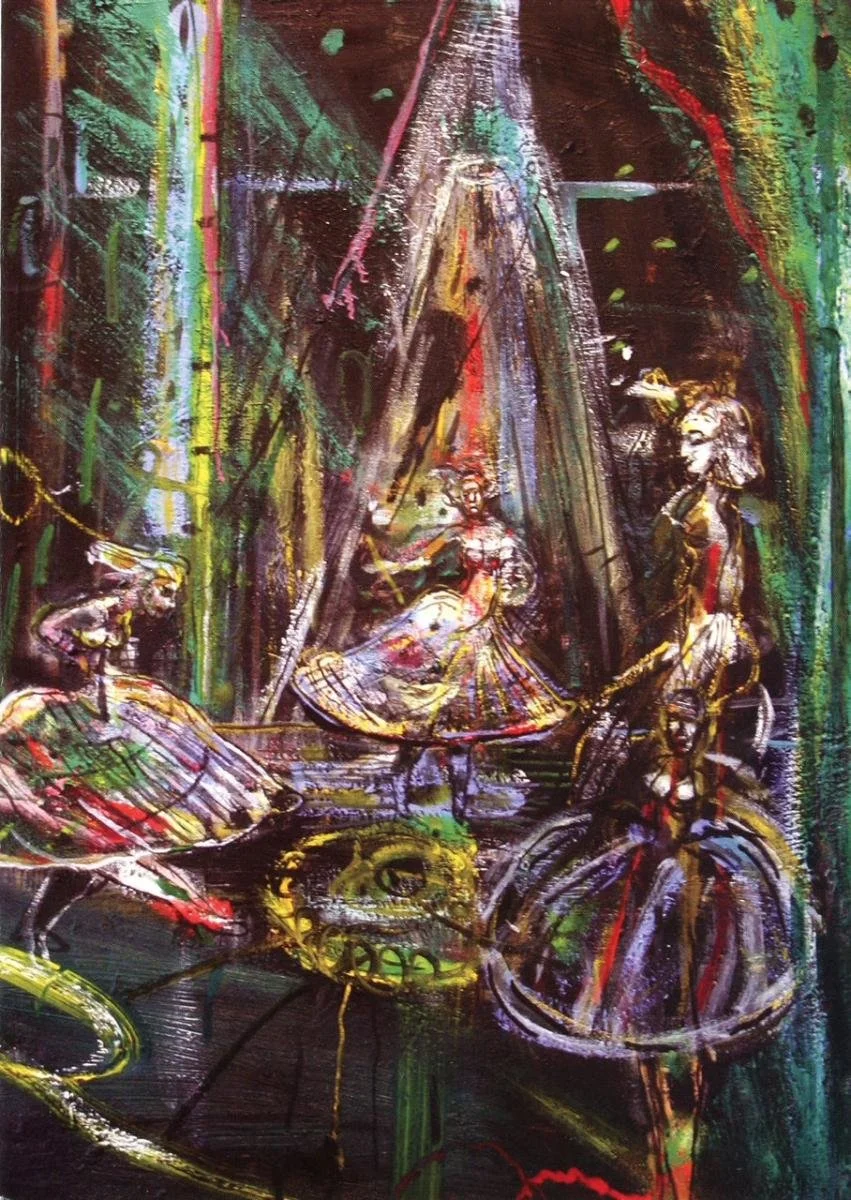
In a wistful moment, I sought out the ghost of Martin Fuller, who was briefly my chum in New Mexico, during my downward spiral. I found I liked his art much more than I had nearly four decades ago. Playful works on paper are what I recall. Full disclosure: I was fanatical and extreme, even vicious, in my shallow and macho aesthetic judgements as an unaccomplished young artist. Not that I was often wrong, mind you, in the long run, which also holds true for Donald Judd, one could point out. Not to suggest my blustery hot takes were on par with his. I wonder if the head trauma, from the motorcycle crash, brawls and football violence (the American kind) exacerbated my volatility. Martin and I hung out a few times drinking at El Farol, And one night our revel was interrupted by the entrance of the poor lady who survived Jackson Pollack’s fatal crash, Ruth Kligman. She carried herself like a dead movie star. We Googled her, Lauren and I, and at first my memories didn’t match the results, until we found some photos of Kligman sporting dyed hair. On a side note: Do you know about the Sullivanians? How an evil psychoanalysis-saturated cult destroyed America’s greatest artist? I recommend the Art Angle podcast episode on the subject, hosted by my former editor Ben Davis. Anyway, I wish I’d gotten to see Martin’s studio in London, to visit his club, where he showed in the end. He told me stories about Francis Bacon holding forth there.

Sir Freake
When I did visit South Kensington, the year was 1996. On a honeymoon stroll with my second wife Sophia, we happened across Francis Bacon’s studio. He was already deceased by then (1992)]. …Before that impenetrable maelstrom of mad inspiration (Bacon’s studio) was relocated and reopened in Dublin, Ireland in 2001. Preserved like a fossil in shale. And also that immensely entertaining plaque honoring Sir Charles James Freake, whom I unofficially adopted as my beloved spectral patron on the spot. This was at the start of what would become me Scottish Travelogue project, wherein I would reconnect with my extended kinfolk on the McLean side, propelled by the completion of my Hanbleceya obligations with Servando. Shaking off the loss of custody of my firstborn son, Will, after years of battles in family court. Not incidentally, I happened to be in Edinburgh for the return of the “Stone of Destiny,” an event met not by a cheering throng of proud Scots, but with massive, onerous and dour silence. From London we were bound for the Highlands and Islands. We were off to Oban, Mull. Staffa, Skye, Callanish, Glencoe, and many encounters and misadventures, culminating in a profusion of art and text created for exhibition and virtual publication.
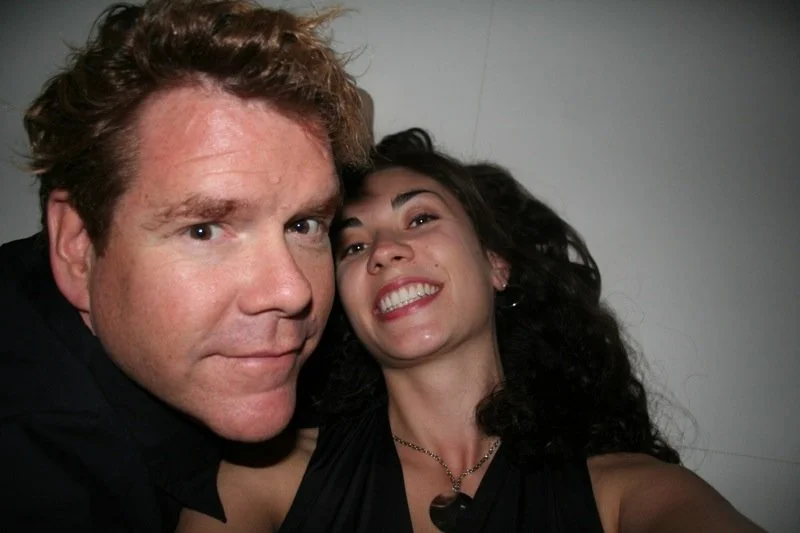
Lula &. I, AFHGC (2007)
I was sure, convalescing after the stroke, my productive artist life had ceased, as such, and my remaining time would be otherwise occupied. Now, I’m having second thoughts. Maybe I was too hasty. Suspended in the interstices of sleep and waking, I’ve been prone to envisioning fabrication sessions, and exhibitions, in tremendous detail. I experienced one such mirage Sunday. I built multimedia constructions from components that exist and are presently in storage nearby. These elements include large hybrid paintings in various stages of finish, to which I added (in my dreaming) layers of tinted Plexi, containing or decorative framing devices and touches of pigment, printed matter, modeling texture and so on; the mounting of small works collaged in series combining elements from previous productions, like CONTENT, Art for Humans Gallery Chinatown, DDDD/01/Journeyman Projects; a new collection sourced from my father’s photos and captions, as they appear compiled in his original scrapbooks, which chronicle our family and community life in Beckley, West Virginia, where I was born and raised.
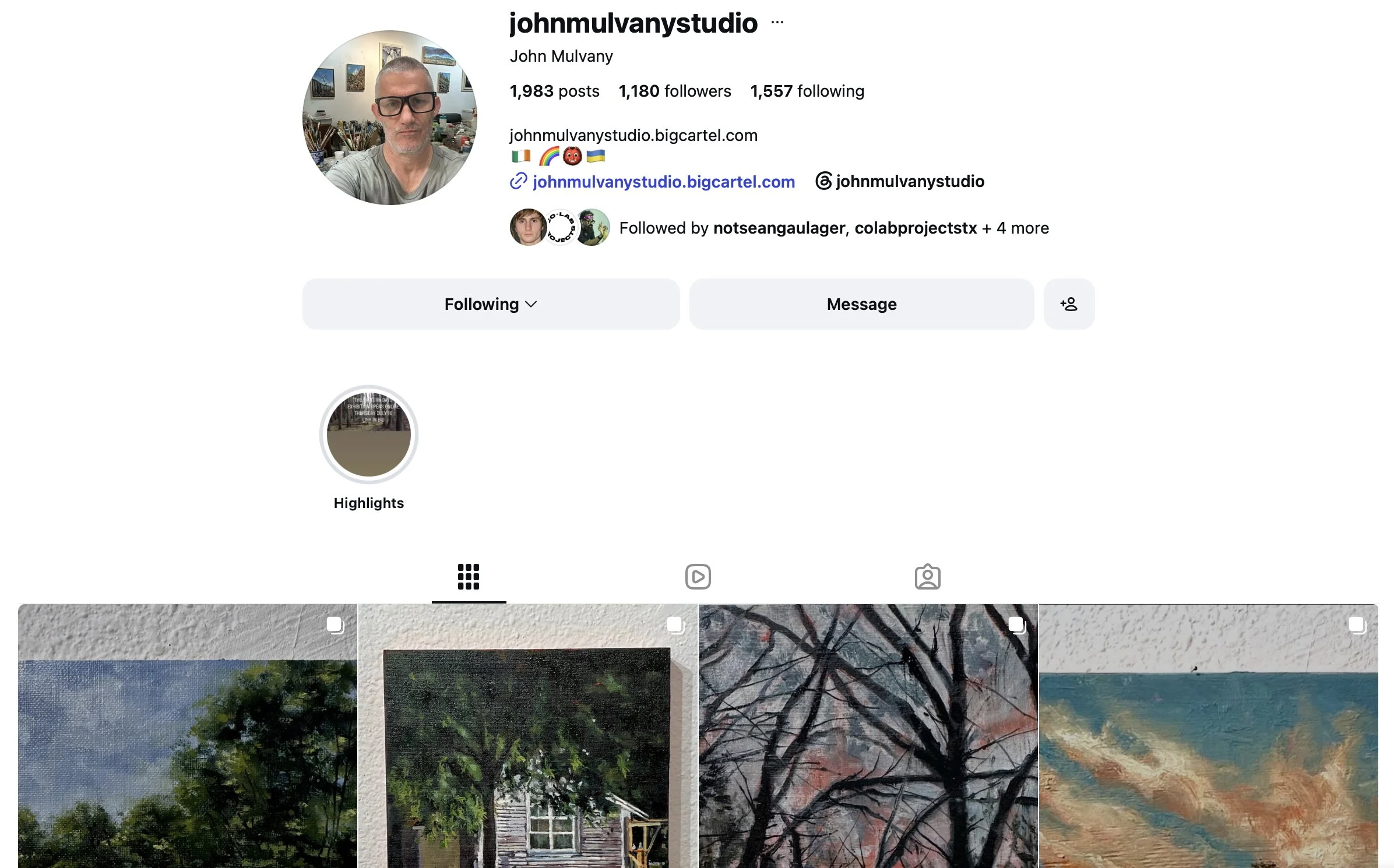
x John Mulvany
The remainder of that Sabbath morning was devoted, after coffee, to advanced play with Instagram feeds, reels and algorithms. These purposeful engagements are underwritten by practical expertise and theoretical literacy. It’s a peculiar post-internet, post-contemporary technical approach, and crazy intense. Think Clockwork Orange mind-saturating, -configuring forced opticals. Interspersed with web crawls of former artsy acquaintances, friends, collaborators, influences, e.g., Hillary Foxworthy, Brent Stewart, John Mulvany, Jim Herrington, Tim Burton and others. I’m still in direct contact with some of them, the breathing, wired ones at least. I’m also chasing discourses tangential to art world trends with parallels in the broader intersecting fields of culture. I would add to the content-context mix politics, finance and system dynamics and effects, but that would improperly characterize my program as abstract to the point of meaninglessness or absurdity.
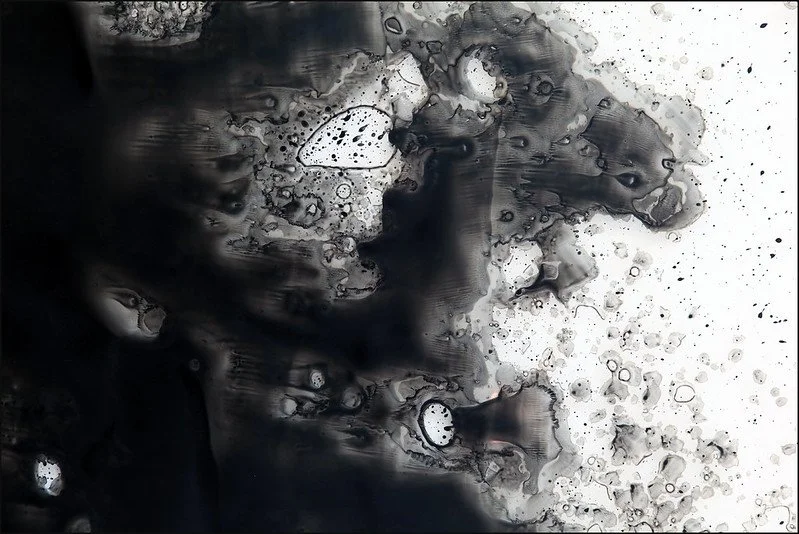
Code Duello 2 (detail), David Lusk Gallery Nashville, TN, 2014
On the contrary, I go granular, baby! In a very compressed metaphysical window, inside the perceptual uncanny of my Lord’s Day phantasmagoria,, I was able to piece together a representative summary, a snapshot, of my mediatic worldview, as a fluid, fractal thing in motion, timely, with both objective and subjective features, presented as a riddle whose answer will come in the form of an art-like response or the absence of one, something in the neighborhood of a signature on an untitled febrile assemblage or mosaic. Whether or not this speculation is realized, the vision itself improves my capacity to properly behave, to enact adequate morality, in the chaotic circumstances of the day. My personhood has perpetuated itself, somehow. Unfortunately for humanity, the Big Picture my weird process mapped in many respects is toxic, dire, unspeakably horrific. Humanity it seems is facing an extinction-level cataclysm, driven by commingling forces and factors, to some degree manmade and, in my view, supernaturally, preternaturally or unnaturally malevolent, which could be distinction without a difference. I can’t discern if that hyperbolic assessment sounds dumbly ambiguous, cliched and even milquetoast, or if it belies a vast well of truthiness. Who can tell, when there’s so much noise and shouting? Bottom line, I am convinced I have no interest in contributing to any panic, appropriate or not. Grinding axes is over for me.
x Radiohead
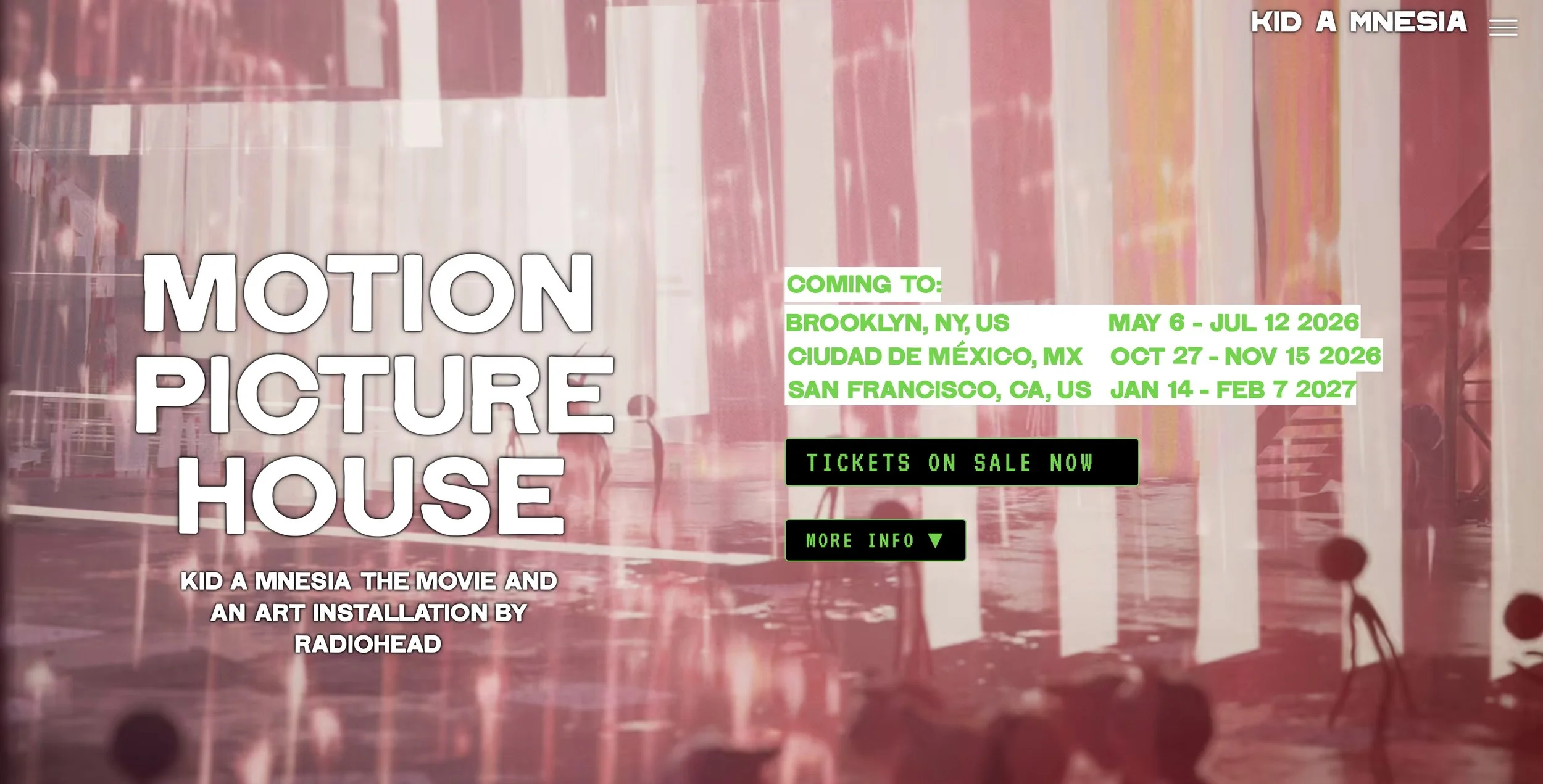
Instead, the proposal on the table, so to speak, involves curation, creation and conservation in triangulation, the context of which is hemispheric. Fomenting a movement, as it were. A recent prime case in point is Kid A mnesiac, an exposition for complementary visuals by Thom Yorke and Stanley Donwood arrayed in an immersive installation energized by a classic Radiohead soundscape. In juxtaposition, as negation: A vacuous digital nihilism, a simulacra of lifey-ness masking the void; that would be Dataland, a Google joint fronted by Rafik Anadol, and a massive flex by the AI industrial complex. Both formulations occur or appear in the pop-up temporary-contemporary realms of soft power, propaganda, and consumer-oriented spectacle. One instance promotes a happy futurism, a smart screensaver, while the other is more accurately aligning with Ginsberg’s Howl — a generational crisis that unfolds as a dystopian cinematic nightmare. One encourages participation and wonder, the other resistance, as in “laying down,” until the moment for rising up arrives. Both are pointedly, materially impermanent. Culture as residue.
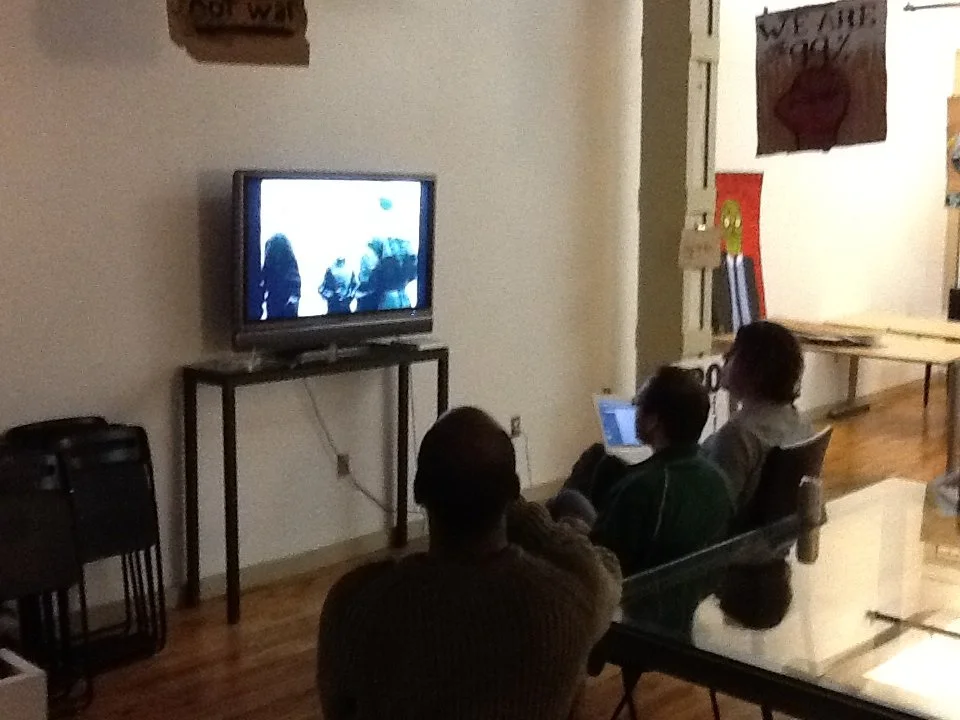
“Lost Causes,” The Anarchives/ the Spatial Occupation at Hyperallergic; Brooklyn , NY, 2012
Not long ago “vibes,” shortened from “vibrations,” which we could explore — a la the Beach Boys, science, etc. — registered style-wise in the hipster pantheon with buzz, status, popular traction. Dread is not a vibe in that sense, although they operate in the mass communication space similarly. What’s up with the latest phase of studied pretense of ambivalence, the neo-non-plus? Is this the sound of tuning out, a marker of informatics overload? A signal not of beats, but of our shared 99% beatdown experience? Its hard to be enthused at the prospects of free thought/speech/will/action/movement during wartime, in the midst of endemic poverty and ubiquitous infirmity, hunger, and the rest of the grim shite. When skies are darkened by smoke from wildfires, eruptions or bombs, it affects us instinctually, which is to say, as animals. You can follow the phenomenon in the feeds, the dread percolating, gaining momentum, accelerating into panic. The algos are the medium, in which fear is transmogrified and consumed, digested and converted into monopoly money, and into a mode of social energy, a raw resource to be refined and/or further redefined to who-knows-what end. The nifty procedural bit involves fabricating a fungible product from processing the equation fear + chaos = uncertainty to cover for rampant pillaging of the commons; that is not traceable to any agent cultivating a specific nefarious, self-aggrandizing outcome. Complication and convolution become camo for the narcissist class, the oligarchy.
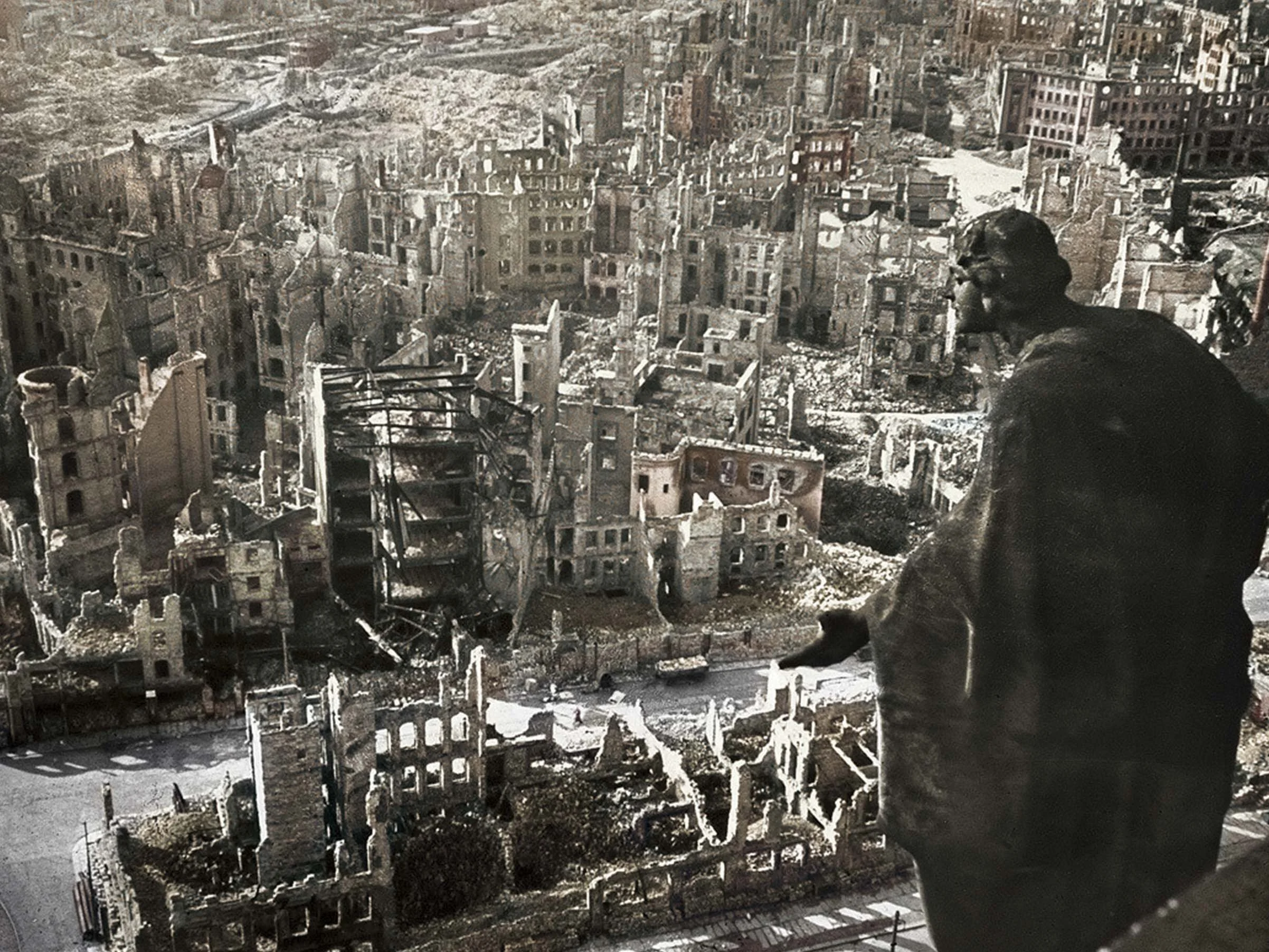
Dresden
A 4D media scan can be as easy as floating down a placid river on an inner tube, or as big a rush as riding class 5 western wilderness rapids with a crew of rowdy friends. Late one evening last weekend, I drifted into Vonnegut’s musings on Dresden in Slaughterhouse 5, turned a bend which put me in the trenches of the first world war, after which I cruised through battlefield Europe part two (narration this time provided by Tom Hanks, a/k/a Captain Miller), or two bazillion, depending on your chronological math. When is Europe not a war zone? About the Drift: one analog to my network dependent protocol would be my old pal John Guider’s habit of hopping in a canoe, splashing into the currents of an American waterway and seeing what happens, through a camera’s lens. I can extrapolate the same model maximally, and posit a thematic and structural linkage to mythos, to Ulysses in fact, whose epic drift is undoubtedly one of the most renowned, and sizzling hot again in 2026. The perpetual Oddysey. Kudos Elon Musk for threatening to bankroll a next-gen AI remake as an immaterial etnhic cleansing flex. Switching lanes: Shout out to the one and only Speed Levitch, and The Cruise, a masterpiece in the genre, and Linklater’s Waking Life. in which Levitch also graphically appears.
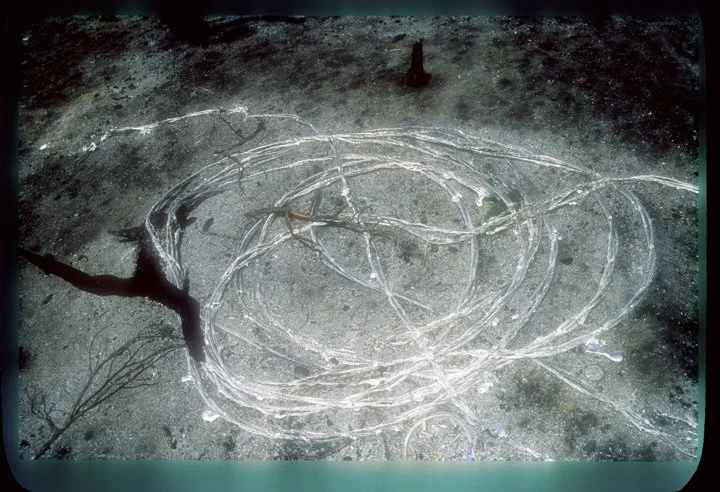
“3 Fire 7,” 2002
If I were to identify a common thread binding my latest meanderings, it would be the collective loss of trust apparent all round. With that loss comes the draining of joy and love from the everyday cycles of life. How realistic is any urge to spontaneity, to furtively enjoin with friends and neighbors in frivolities such as the arts, when civilization burns to ashes and disintegrates? What passes for fun in peacetime and seasons of plenty comes across as madness amidst catastrophe and lack. Struggle is no longer a sign of virtue — it is merely a trudge, a necessary qualification for survival, and no guarantee of anything at all. Faith and hope in relation to art must be reevaluated when contextualized within a framework that supports or at least permits apartheid, genocide or rampant impoverishment of the many, by the endlessly greedy and shameless few, and their minions. Worse yet, it feels like the most terrible among us are getting away with it! Revolution is therefore in the air again, which is to be expected when art has been strangled for the satisfaction of psychopathic despots, frolicking as they commit tyranny. Demanding we worship them, or at least like them, gazing upwards from under the boot.
AFHGC invite